
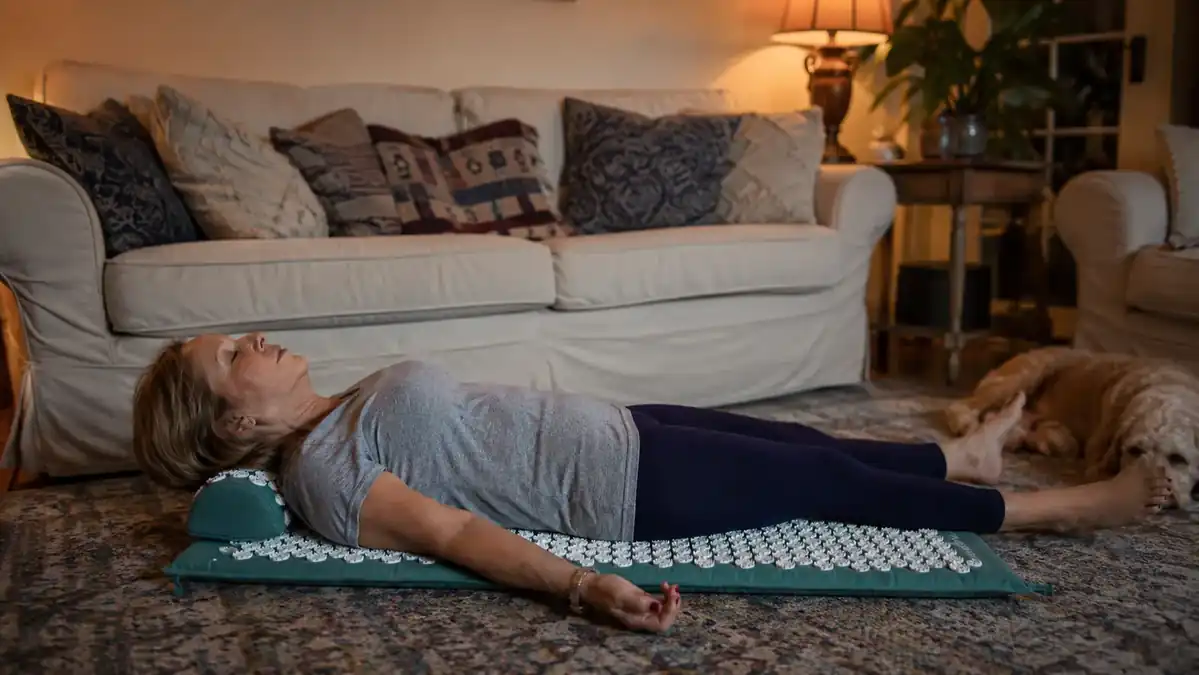
Most evenings by the time I get Scout fed and settle onto the couch, my shoulders have crept up around my ears without my noticing. It's not from anything dramatic, just a full day of the laptop, the steering wheel on a supply run into town, and carrying gear bags at an angle I know better than to use. A physical therapist I saw a few years back for a stiff neck was the one who first mentioned acupressure mats as something worth trying between visits, and that's how a ProsourceFit Acupressure Mat and Pillow Set ended up on my living room floor most nights instead of tucked in a closet.
I want to be upfront about what this is and isn't. An acupressure mat is a relaxation tool, not a treatment, and the research behind pressure-point theory is thin, more tradition than settled science. What I can tell you honestly is what fifteen minutes on the ProsourceFit mat and pillow does for my own ordinary desk-and-driving tightness, and how I've learned to use it so it actually helps instead of just being uncomfortable for no reason. If your shoulder or neck pain is sharp, persistent, or getting worse instead of better, that's a conversation for a doctor, not a mat, and no amount of lying on plastic tabs is a substitute for that visit.
The Mat and Pillow Set I Actually Use Most Nights
This is general wellness content, not medical advice. I use the ProsourceFit Acupressure Mat and Pillow Set because the pillow gives me a way to target my neck and shoulders specifically, not just my back. Check today's price and see the tab density for yourself before you try one.
Amazon Check Today's Price on Amazon →Step 1: Pick a Time When You Can Actually Lie Still
This routine doesn't work if you're rushing it. I do mine after dinner, once the dishes are done and before I'm too tired to bother, somewhere around seven or eight most evenings. Fifteen minutes is the whole thing, but it needs to be fifteen minutes where you're not half-listening for the timer on something else or checking your phone every thirty seconds. Trying to squeeze it into a five-minute gap between chores just leaves you rushing the part that's supposed to slow you down.
I lay the ProsourceFit mat flat on the living room floor, on top of the rug rather than bare hardwood, mostly for a little extra cushion under the parts of my back that aren't in direct contact with the tabs. A yoga mat underneath works too if your floor is hard. The point is a stable, flat surface with enough room to fully lie down without your feet hanging off the end, and enough space around you that you're not knocking into the coffee table when you stretch your arms out.
I also keep the room dim rather than under an overhead light, and I turn my phone face down across the room instead of next to me. None of that is about the mat itself, but it changes how the fifteen minutes feels. A dark room and no notifications buzzing is half the reason this became an actual evening habit instead of something I meant to do and kept putting off.
Step 2: Keep Your Shirt On and Start Short
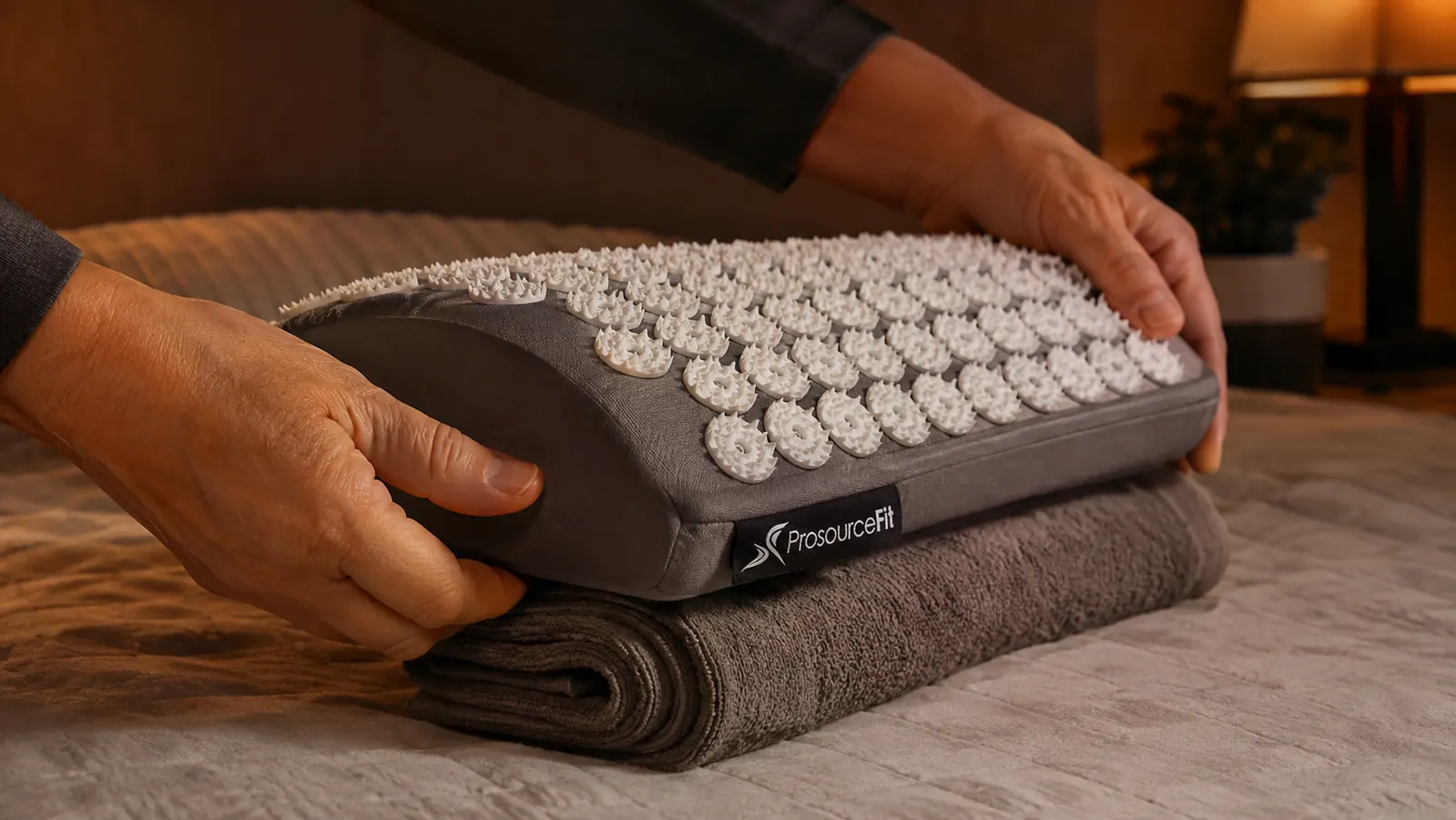
The first time I used the ProsourceFit mat, I made the mistake of lying directly on it with a thin tank top, and it was a lot more intense than I expected, more distracting than relaxing. Now I always start with a regular t-shirt or a light long-sleeve on, and I tell anyone trying an acupressure mat for the first time to do the same. The fabric barrier softens the sensation enough that your body can actually settle into it instead of tensing up against it, which defeats the whole point of lying down in the first place.
First sessions should be short, three to five minutes, not the full fifteen. The sensation eases as your body adjusts over repeated sessions, but there's no reason to push through discomfort to get there faster. If at any point it feels sharp or genuinely painful rather than an intense pressure, get up. That's not the mat working harder, that's a sign to stop, and pushing through sharp pain isn't toughness, it's just ignoring a signal worth listening to.
Once you're used to it, some people go shirtless or in a thin layer for a more direct effect, but I still wear a shirt most nights and it works fine for me. There's no rule that says more direct contact means more benefit, and starting conservative is the right call, especially for the neck and shoulder area where the skin is more sensitive than your low back or thighs. Give it a couple of weeks of shorter, shirted sessions before you decide whether you even want to change anything.
Step 3: Position the Mat and Pillow for Your Shoulders, Not Just Your Back
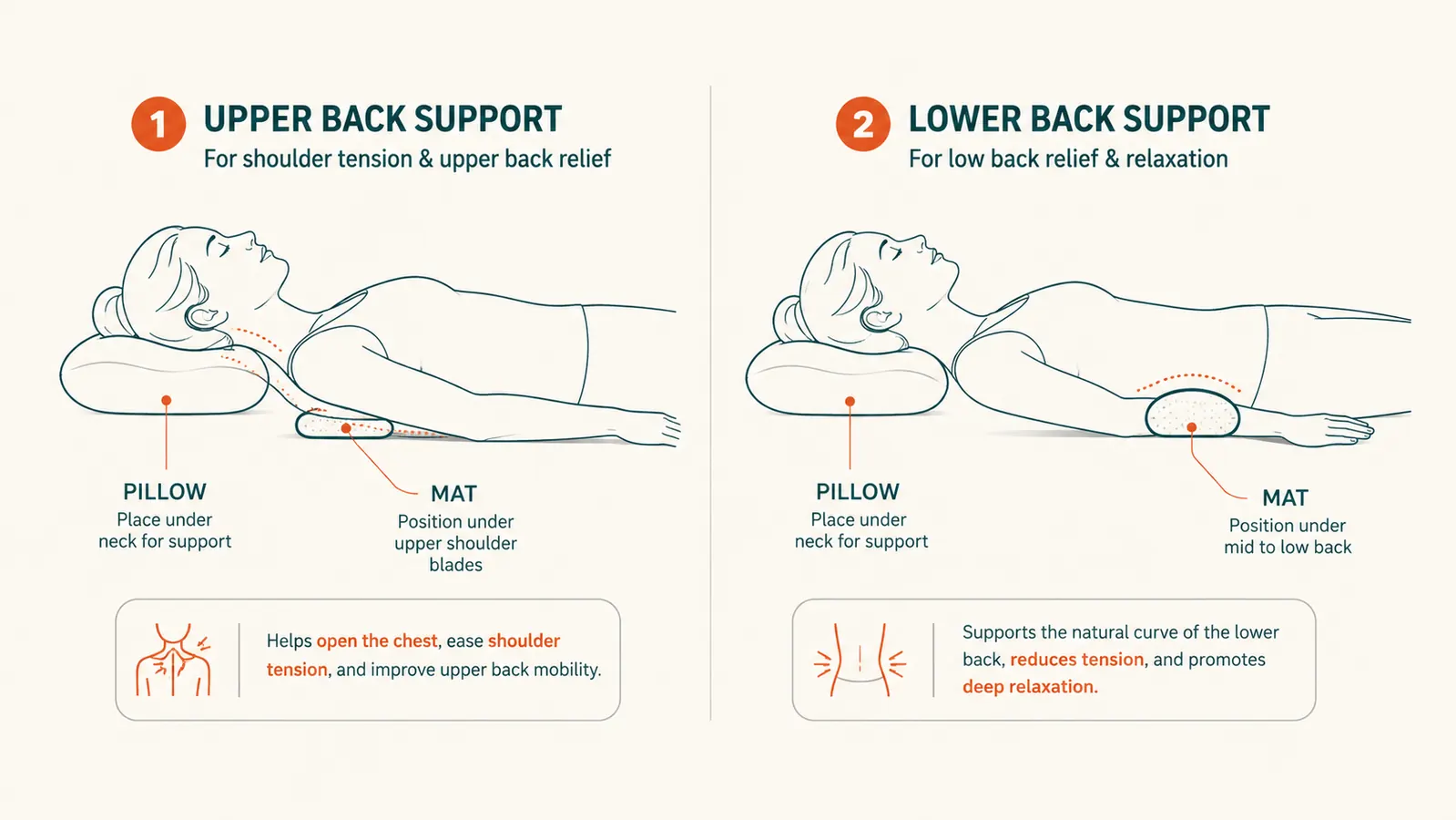
This is the step most people skip, and it's the reason a lot of first tries with an acupressure mat end up doing nothing for the shoulders specifically. If you just lie flat on the mat the way you would for low back tension, most of the pressure lands on your mid and lower back and your shoulders barely touch it. To actually target shoulder tightness, I position myself so the top edge of the mat sits right at my upper shoulder blades, not lower down toward the middle of my back.
Then the ProsourceFit pillow goes under the base of my neck, right where the neck meets the shoulders, propped so my head tilts back slightly rather than staying flat. That combination, mat under the upper shoulder blades and pillow under the neck, is what actually reaches the muscles that tighten up from hours of looking down at a screen or gripping a steering wheel. Lying flat with no pillow mostly misses the spot entirely for shoulder-specific tension, which is the mistake I made for the first week or two before I figured out the placement mattered this much.
If the pillow feels too intense right under the base of the skull, I'll shift it down an inch or two so it sits more squarely on the meaty part of the upper shoulders instead of right at the neck. Small adjustments like that make a bigger difference than people expect, and it's worth spending your first few sessions just experimenting with an inch here or there rather than assuming the first position you land in is the right one.
Step 4: Breathe Slow and Let Your Arms Fall Open
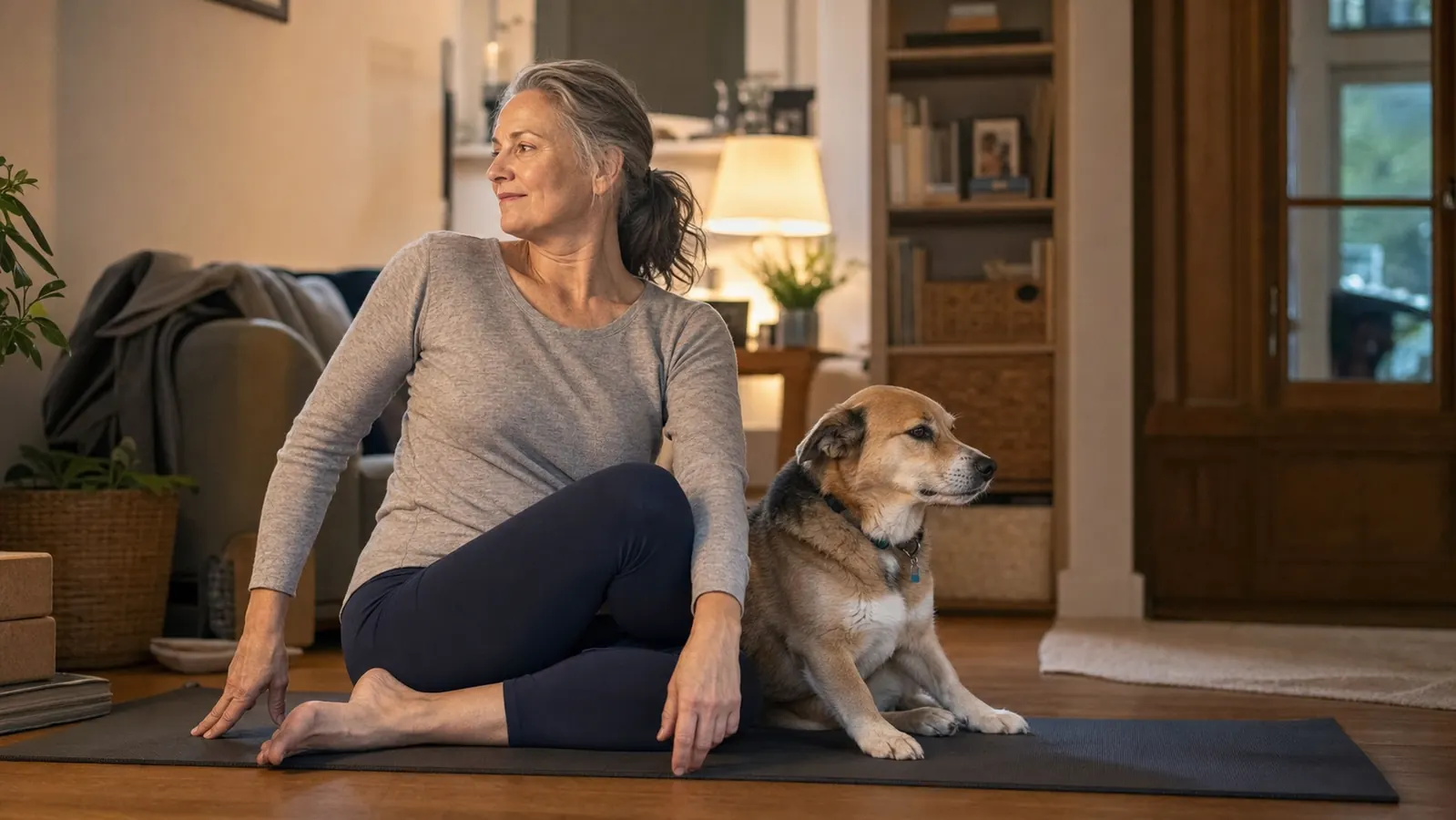
Once I'm positioned, I let my arms fall open to the sides, palms up, rather than keeping them tucked in close. That small change makes a real difference. Arms tucked in tend to pull the shoulders forward and up, working against what you're trying to undo. Arms open and relaxed let the shoulder blades settle back against the mat instead of hovering just above it, which is where the actual pressure and release happen.
From there it's just breathing. Slow inhales through the nose, longer exhales, nothing complicated. I've found the first two or three minutes are the hardest, my shoulders want to tense up against the sensation instead of sinking into it, and then somewhere around minute four or five they just let go. That's the part I'm actually there for, not the pressure itself but the release that comes after the initial resistance passes, the same way your shoulders drop an inch the moment you finally sit down after a long day on your feet.
I don't try to think through the day or plan tomorrow during this part, even though my brain wants to. I've had better luck just counting breaths, in for four, out for six, than trying to meditate in any formal sense. It gives my mind something small to hold onto so it isn't drifting back to my inbox while my shoulders are trying to unclench.
Step 5: Come Up Slowly and Give It a Minute
When the fifteen minutes are up, I don't jump straight to standing. I roll to one side first, push up slowly with my hands, and sit for a moment before getting all the way up. Coming off the mat too fast can leave you a little lightheaded, especially the first few times, and there's no reason to rush the end of something meant to slow you down in the first place.
Once I'm sitting up, I roll my shoulders back a few times and check in with how they feel compared to when I lay down. Most nights they're noticeably looser, not dramatically transformed, just looser, the kind of difference where I notice I'm not hunching over the sink doing dishes the next morning the way I was before. Some nights it's subtle. I've stopped expecting every session to feel like a breakthrough, and that's made the routine easier to stick with, honestly.
I roll the ProsourceFit mat back up and set it against the wall by the couch rather than putting it away in a closet, mostly because if it takes any real effort to get it out again, I know myself well enough to know I'll skip it on the nights I need it most. Keeping it visible and within reach has done more for my consistency than any amount of good intentions ever did.
What Else Helps
The mat handles the end-of-day part of this, but shoulder tightness for me is mostly a daytime problem that shows up at night. Standing up from the desk every hour, even just to refill water or let Scout out, does more for my shoulders over a full week than the mat alone ever could. I've also started paying attention to where my laptop sits, since a screen that's too low is the single biggest reason my shoulders creep up while I work, and propping it on a stack of books to bring the top of the screen closer to eye level made a noticeable difference within a few days.
If you want to compare tools before deciding what to add to your own evening, I've written up how an acupressure mat stacks up against a foam roller for this kind of tension, and a separate piece on other ways one has helped with general back tension, both worth a look if you're still deciding whether this fits your routine. I also try to keep an eye on how I'm carrying bags and gear during the day, since favoring one shoulder for a heavy tote or a cooler tends to undo a lot of the evening's work by the next afternoon.
The mat doesn't undo a whole day of bad posture. It just gives my shoulders fifteen minutes where nothing is asking anything of them.
Where the Mat Actually Lives Now
Mine used to sit rolled up in a closet and now it stays leaned against the wall by the couch, ready to go without any extra effort at the end of the day. See today's price on the ProsourceFit Acupressure Mat and Pillow Set and decide if it fits your own evening wind-down.
Amazon Check Today's Price on Amazon →