
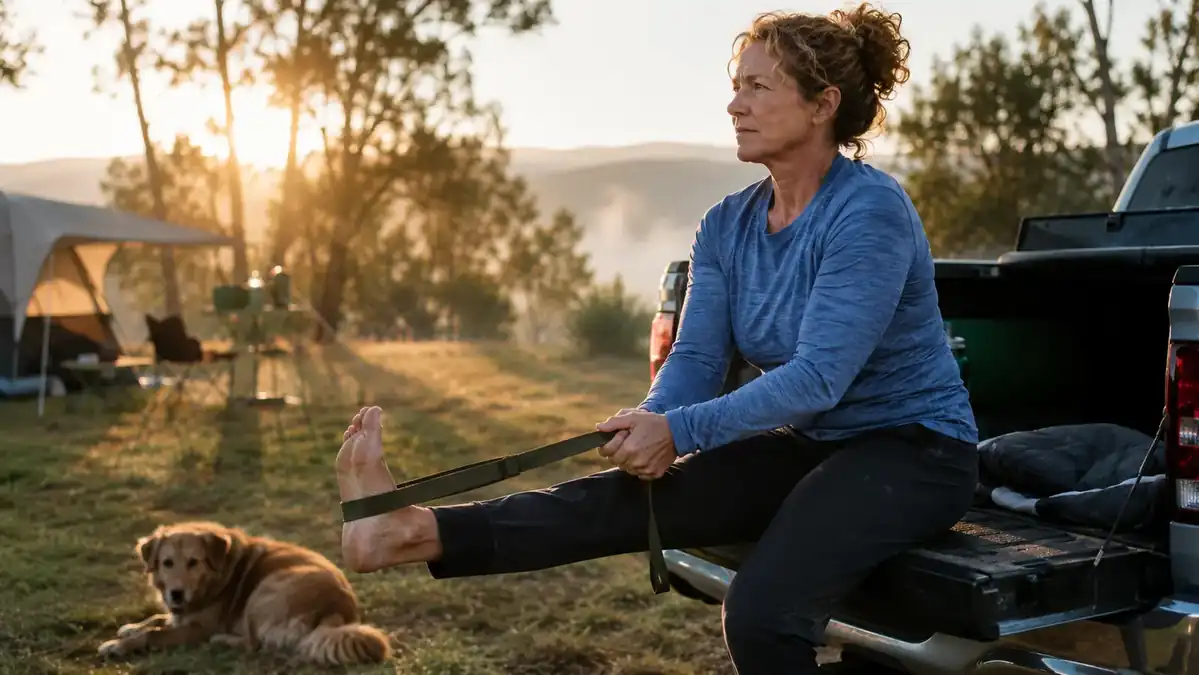
If you've got fifteen minutes before a hike and hips that took a full flight of stairs to loosen up, here's the short answer: a stretch strap gets you deeper, more controlled range in less time, and a resistance band is the better tool once you're actually trying to build strength around that mobility. I've used both for the better part of a year, the Trideer Stretching Strap most mornings and a basic loop resistance band on the days I'm doing hip and glute work at home. They solve two different problems, and mixing them up is where most people waste money and end up frustrated with the wrong tool.
Here's where I landed after enough stiff mornings to know the difference. The strap is what goes in my daypack next to the water bottle, because a hamstring or hip flexor that's locked up at six in the morning on a camping trip doesn't respond well to bouncy resistance work, it needs slow, held tension instead. The band lives in my gym bag for glute activation before I load anything heavier, or for the evenings when Scout and I have already put in six miles and my hips need something more active than a passive hold. Below is the honest side-by-side, then where each one actually wins, because neither one covers the whole job on its own, no matter what the packaging implies.
I want to be clear about what I mean by tight hips before we get into the comparison, because the term gets used loosely. For me it's the specific kind of stiffness that sets in after a long drive to a trailhead, or after sitting through a flight, or just from a desk job that keeps my hip flexors shortened all week. It's not an injury, it's a range-of-motion problem, and the two tools below approach that problem from opposite directions. One holds a stretch still. The other adds load while you move. Understanding which category your morning stiffness actually falls into decides which product is worth buying first.
| Category | Trideer Stretching Strap | Resistance Band |
|---|---|---|
| Cost | One-time purchase, no consumables or replacements | Similar range, but sets are often replaced as bands wear or snap |
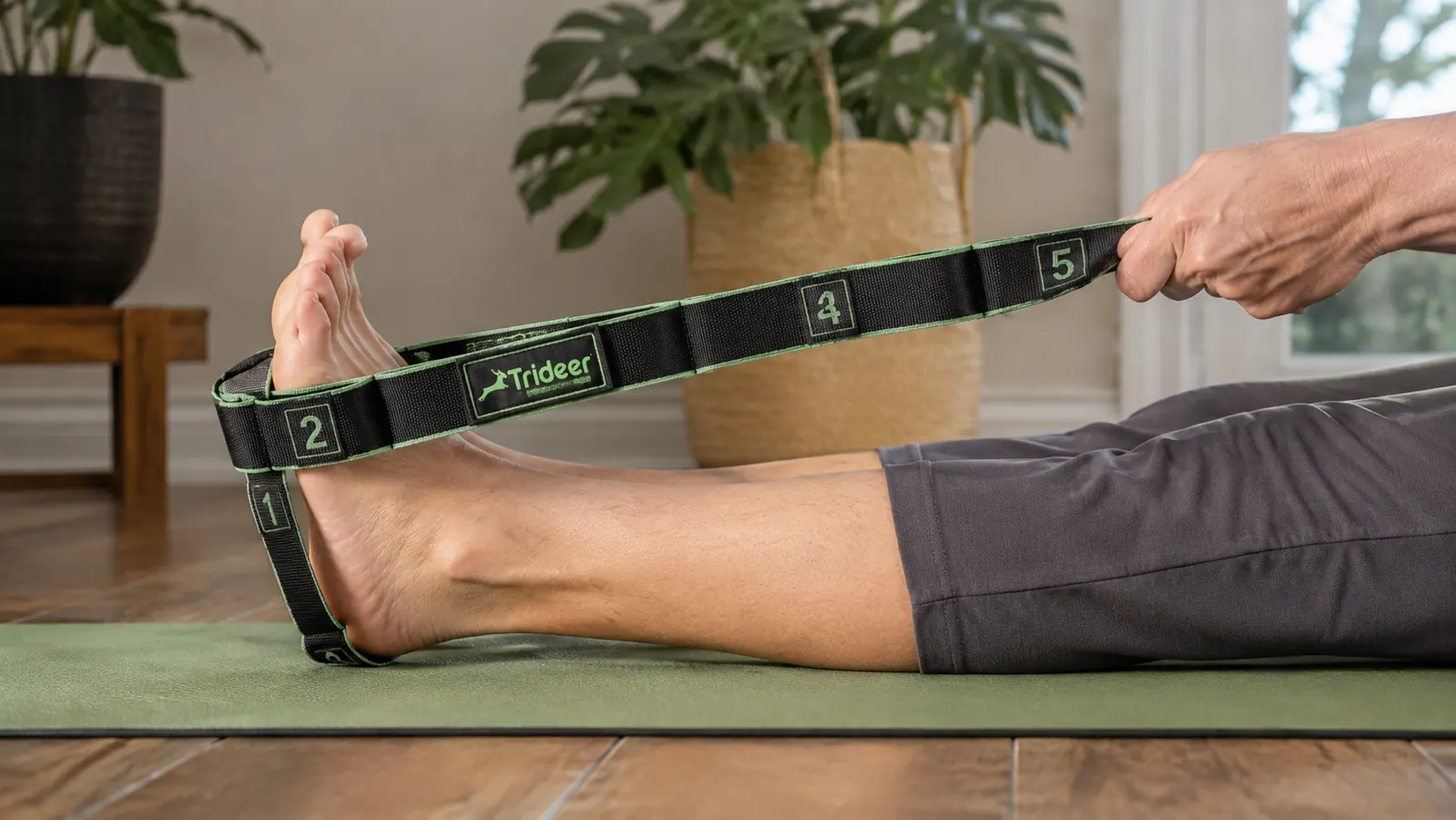
| Material & Construction | Non-elastic woven webbing with 12 stitched loops and a padded foot loop | Elastic latex or fabric loop, no fixed measurement points |
| Primary Use | Static stretching, holding a position at a fixed depth | Dynamic resistance work, activation, and strength movements |
| Portability / Pack Size | Rolls flat, about the width of a belt, barely six ounces | Packs small too, but a set of three to five resistance levels takes more room than one strap |
| Stretch Depth Control | Numbered loops let you hold the exact same depth every morning and track progress | Depth depends on grip and pull, harder to repeat exactly day to day |
| Best For Strength & Activation Work | Not built for resistance training, the webbing doesn't stretch | Adds real resistance to glute bridges, band walks, and shoulder work |
| Joint-Friendly for Stiff Mornings | Fixed length means no snapback, gentle on a hip that's still waking up | Elastic tension can overshoot if you're not warmed up yet |
Where the Trideer Strap Wins
The biggest reason I still reach for the Trideer strap over a band on stretch days is the numbered loops. There are twelve of them running the length of the webbing, so I know exactly how far I pulled my hamstring into a stretch on day three versus day forty. That kind of feedback matters more than it sounds like it should. When my hips are locked up from a long drive to a trailhead, I'm not trying to guess my way into the right depth, I want to hit the same mark I hit last week and see if it's gotten a little easier. A resistance band gives me none of that, it just gives me tension that changes with how far I happen to pull that particular morning.
It's also just calmer on a joint that hasn't woken up yet. There's no elastic snapback with the Trideer strap, no risk of the tension pulling harder than I meant it to if my grip slips at six in the morning before I've had coffee. I hold the loop, I lean into it slowly, and the tension stays exactly where I put it until I choose to move it. For someone in their late forties with a hip that complains before the kettle's even boiling, that predictability is worth more to me than the added resistance a band offers, especially on the mornings I'm still half asleep and not paying close attention to form.
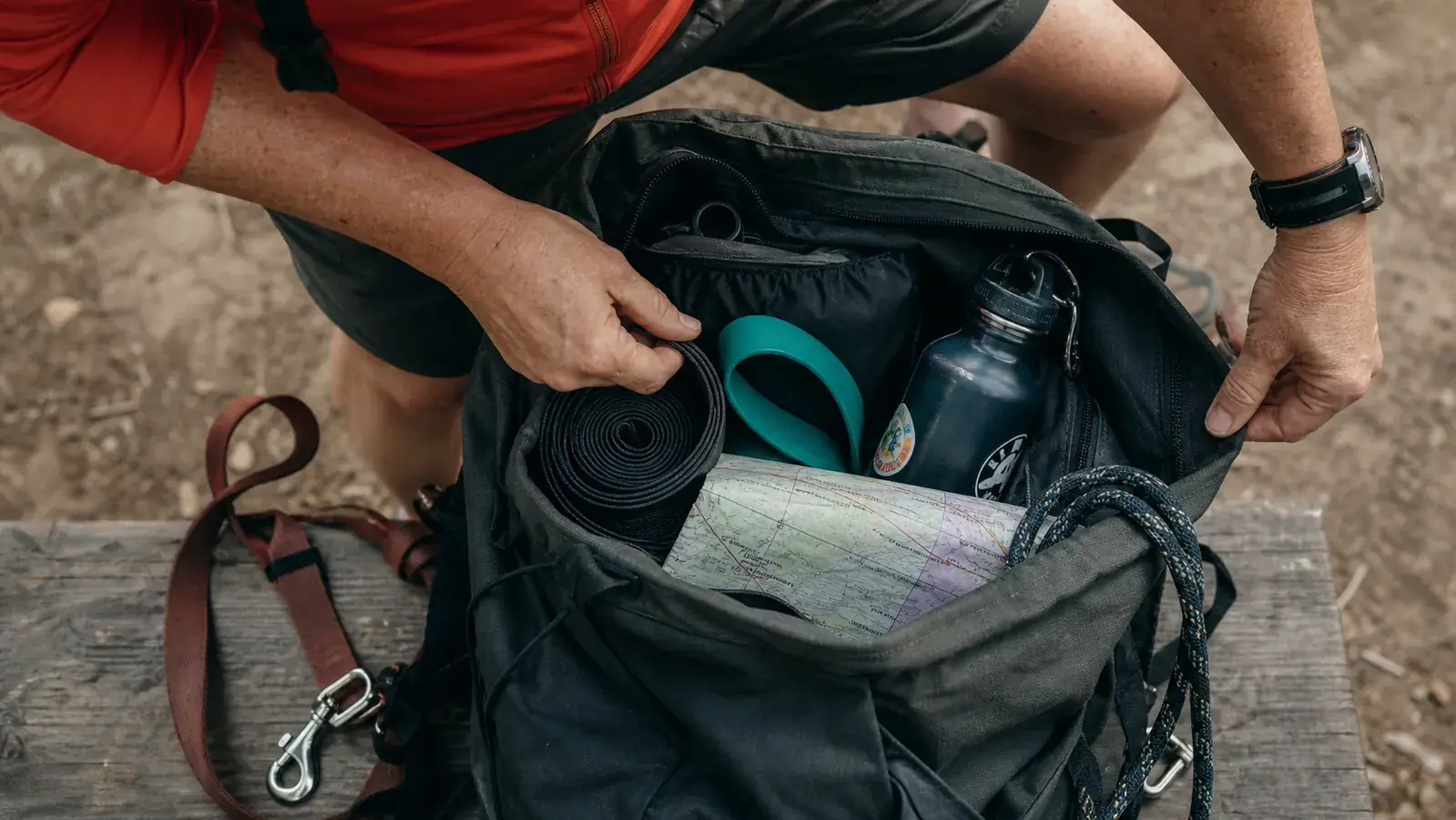
There's a practical side to this too. The strap rolls flat and thin, so it goes in the outside pocket of my daypack without taking up the space I need for water and snacks. On a three-day camping trip that matters more than it sounds like it should when you're trying to keep pack weight down. A full resistance band set, even a light travel one, takes up noticeably more room once you've got three or four resistance levels in there, and I've never once needed more than one strap length for the stretches that actually loosen my hips before a hike.
Durability was the thing I worried about least going in and I probably should have worried about it more, at least with a band. The webbing on the Trideer strap has held its stitching through months of being rolled, unrolled, rained on at a campsite, and left in a hot car more than once. A fabric or latex resistance band, by comparison, is the part of my kit I've had to replace before, since elastic loses its snap over time in a way that fixed webbing simply doesn't. If you're buying for the long haul and not just a season, that's worth factoring in before you decide.
Where the Resistance Band Wins
I won't pretend the strap does everything, because it doesn't. When I'm working on the actual strength around a stiff hip, not just the flexibility, the band is the better tool by a wide margin. Glute bridges with a loop band around my knees, lateral band walks before a hike, banded clamshells before bed, none of that works with a strap because the webbing simply doesn't stretch. If the goal is building the muscle that keeps a hip from getting stiff in the first place, rather than just loosening it up after the fact, a band earns its spot in the bag too, and honestly it should have been in mine a lot sooner than it was.
It also travels lighter for full-body work. One resistance band covers hips, shoulders, and ankles in a way a stretch strap can't, since the strap is really built for one motion pattern held statically at a time. On a multi-day camping trip where pack weight matters and I want one tool that covers more ground, the band's versatility is a real advantage, even if it's less precise for pure stretching. I've used a light band for shoulder work on rainy mornings in a tent when there wasn't room to lay out and use the strap properly, and it did the job fine.
The price gap matters to some people too, and I don't think it should be dismissed. A basic resistance band, especially a single loop instead of a full graduated set, can come in under what the Trideer strap costs at today's price. If money is genuinely tight and you can only buy one thing this month, the band's lower entry point and broader range of movements is a reasonable argument in its favor, even though I still think most people's actual complaint, morning stiffness, points them toward the strap first.
One honest downside on the band side is the learning curve. A stretch strap only asks you to pull a loop and hold still, but a resistance band asks you to control tension through a range of motion, and I've seen it done badly, knees caving in on a band walk, shoulders shrugging on a pull-apart. It's not dangerous exactly, but it's easier to reinforce a bad movement pattern with a band than it is with a strap, where there's really only one way to use the thing. If you're brand new to either tool and nobody's coaching your form, that's worth knowing going in.
Stiff Hips Don't Loosen Up on Their Own
The Trideer Stretching Strap is the one I actually pack, twelve loops for exact depth, flat enough to roll into a daypack pocket, and it's still holding up after months of near-daily use. See today's price and decide for yourself before your next early trailhead morning.
Amazon Check Today's Price on Amazon →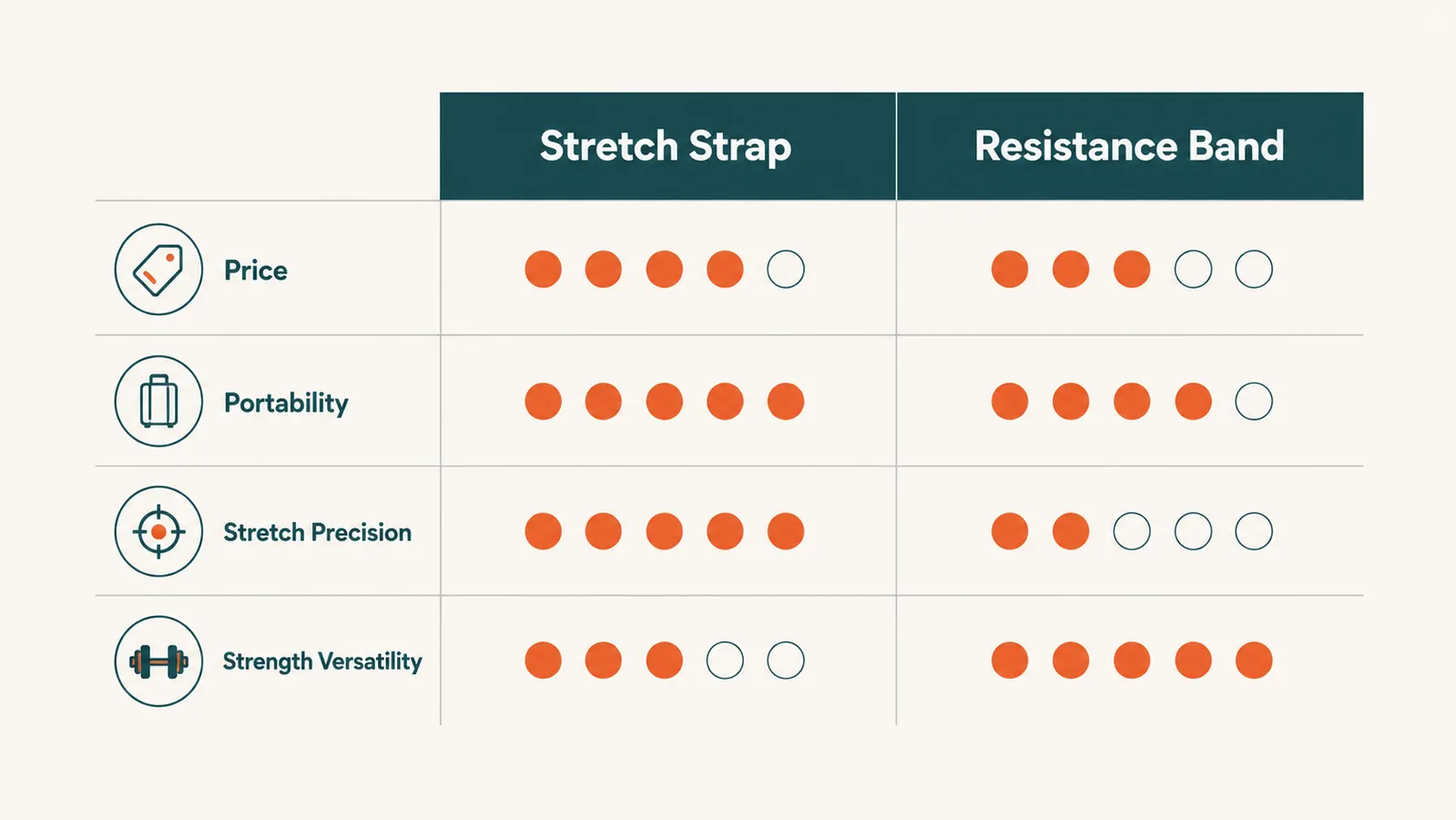
How I Actually Use Both, Together
In practice I stopped treating this as an either-or decision months ago. Most mornings before Scout and I head out, I spend about six minutes with the Trideer strap on my hamstrings, hip flexors, and calves, just holding each stretch at the same numbered loop I used the day before. That's the piece that gets me moving without wincing on the first hundred yards of trail. On the days I'm doing a longer strength session, usually two or three times a week, the resistance band comes out afterward for glute and hip work, because by then I'm warmed up and ready for load instead of just range.
The order matters more than people expect. Doing banded strength work on a genuinely stiff, cold hip has never felt as good to me as stretching first with the strap and then adding the band once things are loosened up. It's the same logic as warming up before you sprint. If I had to strip my routine down to one tool for a short trip, it would be the strap, simply because morning stiffness is the more consistent problem I run into. But on a longer trip, or during a stretch of weeks where I'm trying to actually build hip strength and not just manage soreness, I pack both without a second thought.
Who Should Buy Which
If your problem is a stiff hip or hamstring in the morning, before a hike, before a flight, before you've even had coffee, get the strap first. That's the more common complaint I hear from people my age, and it's the one the Trideer strap solves directly, with loops that let you hold a consistent, gentle stretch instead of guessing at how far is far enough. It's also the cheaper, simpler entry point if you've never used either tool before, since there's really only one way to use it wrong, and that's pulling too hard too fast.
If your problem is closer to weakness, like a glute that isn't firing and keeps letting your hip take the load on a long trail day, add a resistance band to the same routine. It won't replace the strap for stiff mornings, but it fills a gap the strap was never built to fill. Most people I know who still feel good at fifty eventually own both, using the strap to loosen up and the band to build the strength that keeps them from getting stiff again in the first place. Neither of us started there, and you don't have to either. Start with whichever problem is actually costing you a good morning right now.
Start With the Strap, Add the Band Later
If mornings are the actual problem, fix mornings first. The Trideer Stretching Strap is the simpler, cheaper place to start, and it's still the one in my bag four camping seasons later.
Amazon Check Today's Price on Amazon →