

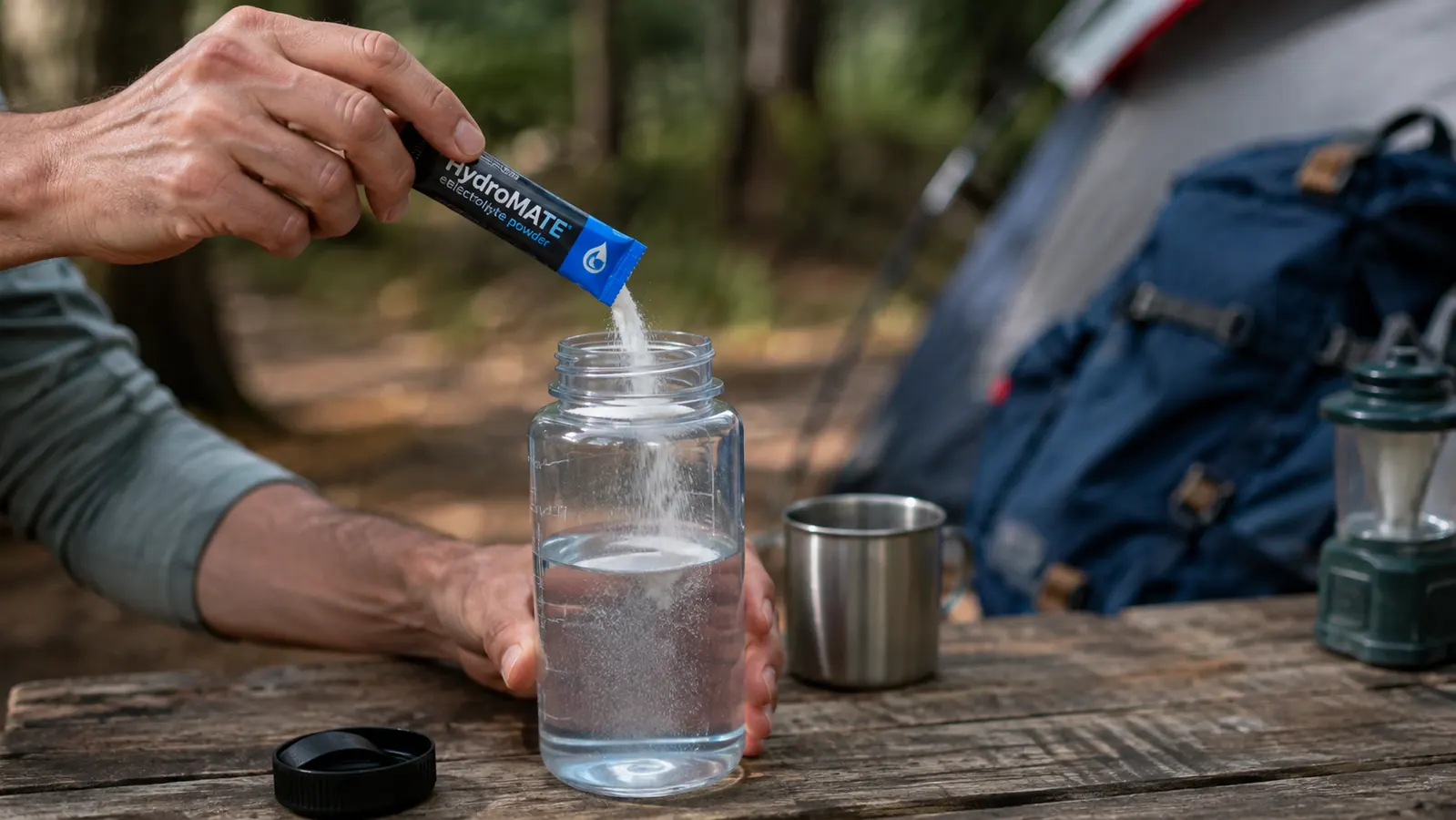
For years my hiking pack held a bottled sports drink tucked next to the trail mix, the same habit I'd had since college. That started changing about eight months ago on a nine mile loop outside Flagstaff where I got a headache and a wave of nausea around mile six that had nothing to do with effort and everything to do with how much I'd been sweating in the dry heat without replacing what I was losing. A hiking friend handed me a HydroMATE electrolyte packet, I mixed it into my water bottle at the next overlook, and by the time we got back to the trailhead I felt like a different person. That's the short version of why I now carry both, but not for the same reason, and not in equal amounts.
Here's the honest answer before the breakdown. HydroMATE electrolyte packets are the better choice for real hydration on a long hike, mainly because of how much more sodium they carry and how little sugar comes with it. A bottled sports drink wins on convenience, since you can grab one at literally any gas station on the drive to the trailhead without planning ahead. Neither one is wrong to carry. They're just solving slightly different problems, and mixing up which one you reach for is how a lot of people end up either underhydrated on a hot trail or drinking more sugar than they meant to.
I want to be specific about what problem I'm actually solving here, because hydration gets talked about too vaguely. On a hike that runs four or more hours, especially in dry Arizona heat, I sweat out more sodium than plain water replaces, and that's what leads to the headachy, slightly nauseous feeling I had that day outside Flagstaff. It's not about being an endurance athlete, I'm 52 and I hike for the same reason I always have, to keep up with Scout on the trail and not have to sit out a camping weekend because my body quit on me. The two products below approach that problem from very different angles, and the table underneath spells out where each one actually earns its spot in the pack.
| Category | HydroMATE Electrolyte Packet | Bottled Sports Drink |
|---|---|---|
| Sodium Content | Around 1,000mg of sodium per packet, built for real sweat loss on a long hike | Roughly 150 to 200mg of sodium in a typical 20 ounce bottle, noticeably lighter |
| Sugar Content | Low sugar formula, about 1g per packet in most flavors | Around 34g of sugar in a classic 20 ounce sports drink, closer to a soda |
| Weight & Pack Space | Flat foil packet, weighs almost nothing, a handful fits in a hip pocket | Plastic bottle takes up real space and weight in a pack or cooler |
| Preparation Needed | Requires water and a bottle to mix into, an extra step mid-trail | Ready to drink straight out of the bottle, no mixing at all |
| Availability on the Road | Only available if you packed it or planned ahead at a specialty or grocery store | Sold at nearly every gas station, vending machine, and grocery checkout in the country |
| Taste & Familiarity | Tart, subtly sweet powder, mixed to whatever strength you prefer | Familiar, consistent flavor most people grew up drinking, no adjusting needed |
| Hydration Per Ounce Carried | Concentrated dose of electrolytes for very little weight, mixes into water you're already carrying | Mostly water and sugar, so you're carrying more liquid weight for less actual electrolyte value |
Where HydroMATE Wins
The sodium number is the whole reason I switched. A single HydroMATE packet carries roughly five times the sodium of a typical bottled sports drink, and that's the mineral I actually feel the lack of when I'm hiking in dry heat for hours at a stretch. A bottled sports drink was designed decades ago mostly around sugar for quick energy, with electrolytes almost as an afterthought, which is fine if the goal is a burst of energy during a short game, but it's not what I need at mile six of a nine mile loop when my legs are fine and my head is the thing starting to complain.
The low sugar formula matters just as much to me now that I'm paying attention to it. A 20 ounce bottled sports drink can carry over 30 grams of sugar, which is close to what's in a can of soda, and drinking two or three of those across a long travel day adds up to a sugar load I don't actually want, especially on a day I'm already sitting for hours in a car or on a plane. HydroMATE's low sugar packets let me hydrate the way I actually need to without the sugar crash that used to hit me an hour after finishing a bottled drink on a long drive to a trailhead.
Pack weight is the third piece, and it's a bigger deal than it sounds on a multi-day camping trip. A dozen HydroMATE packets weigh next to nothing and take up less room than a single bottled drink, which matters when Scout's food and the tent are already fighting for space in the same bag. I can carry enough electrolyte packets for four or five days of hiking in the same pocket that would hold one bottled drink, and on a trip where every ounce in the pack gets weighed against something else, that's not a small advantage.
Where the Bottled Sports Drink Wins
I'm not going to pretend the bottled drink doesn't earn its place, because it genuinely does on the days that matter most. There's zero prep involved. If I'm already moving, already sweating, and I stop at a gas station on the drive up, I can grab a bottle and be drinking it in the parking lot thirty seconds later. HydroMATE packets require water in a clean bottle and a minute to mix, which is fine when I'm at a campsite or a trailhead with my own supplies, but it's genuinely inconvenient if I'm caught without a bottle or clean water source and just need something to drink right now.
Availability is the other honest advantage, and it's a big one. I can find a bottled sports drink at literally any gas station, grocery store, or vending machine between home and any trailhead in the country. HydroMATE packets are something I have to plan ahead for, order online or find at a specific store, and pack before I leave. If I forget them at home, which has happened more than once before a long weekend, a bottled drink from the last gas station before the trailhead is a perfectly reasonable backup, and I don't feel bad reaching for one in that situation.
There's also the taste factor, which matters more for consistency than people give it credit for. A bottled sports drink tastes the same every single time, no mixing ratio to get wrong, no risk of making it too weak or too strong. HydroMATE packets are tart and take a little getting used to, and I know a couple of hiking friends who never quite warmed up to the flavor even after trying several varieties in the pack. If taste familiarity is what gets you to actually drink enough on a hot day, that's worth more than any nutrition label, since the best electrolyte product is the one you'll actually finish.
The Difference Shows Up Around Hour Four
A bottled drink gets you through the first hour just fine. HydroMATE electrolyte packets are what I actually reach for once the hike gets long and the heat starts working against me, five times the sodium and a fraction of the sugar in a packet that weighs nothing. See today's price and toss a few in your pack before your next long trail day.
Amazon Check Today's Price on Amazon →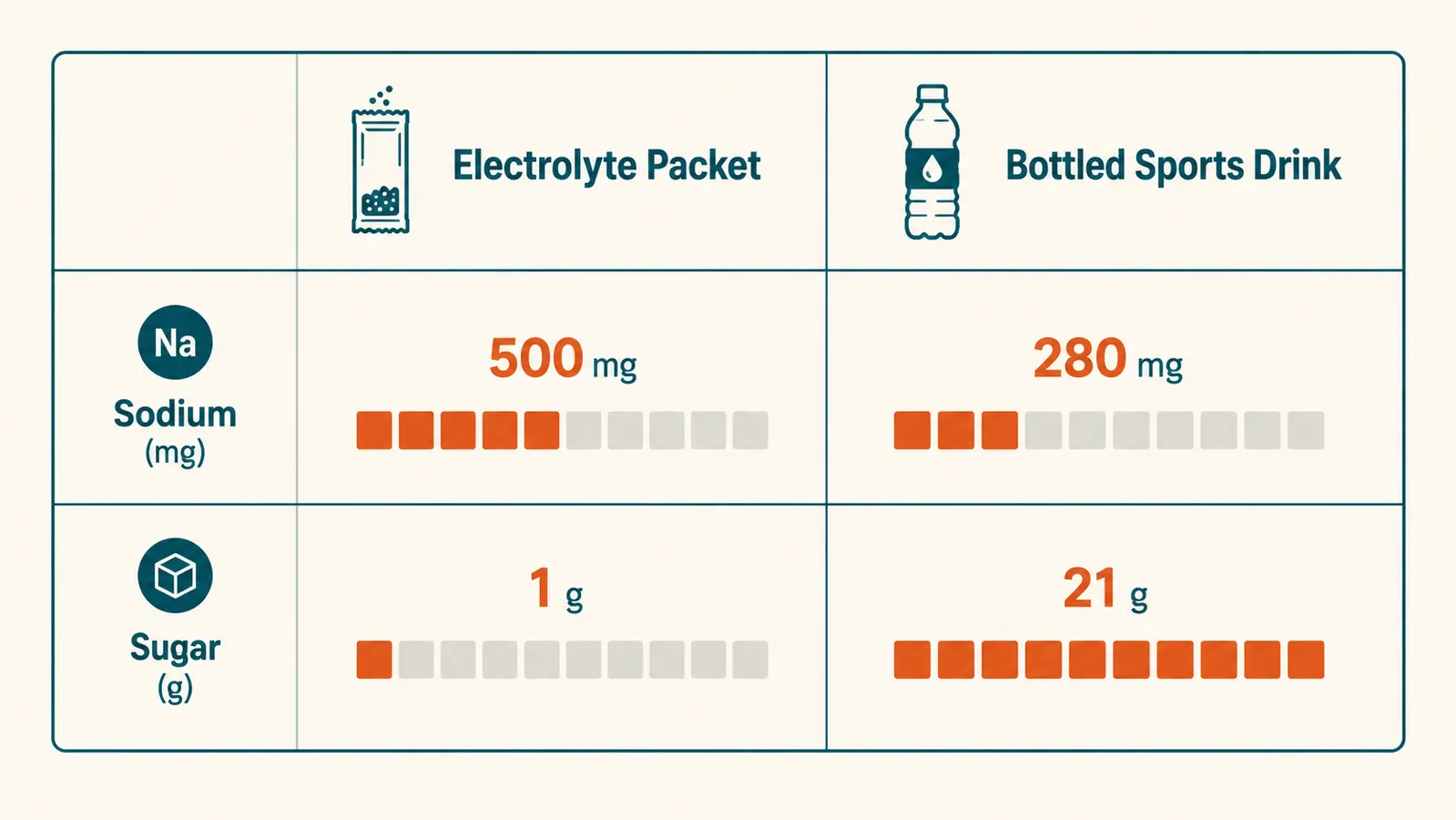
How I Actually Use Both on the Trail
In practice I've stopped treating this as a strict either-or decision. A few HydroMATE packets go in every pack I carry, whether it's a day hike or a week of camping, because they're the tool for real, planned hydration on a hike that runs past two or three hours. I mix one into my water bottle before I even leave the trailhead parking lot, then usually a second one around the halfway point if it's hot, and that steady approach is what's kept me from repeating that Flagstaff headache since I started doing it that way.
The bottled sports drink is still in the mix, just for a different moment. If I'm driving straight through to a campsite and don't want to dig through the cooler for my own supplies, or if I've genuinely run out of packets on a longer trip, grabbing one from the last gas station before we lose signal is a fine backup plan. I don't treat it as a failure, it's just the convenience option for the times HydroMATE isn't within reach, and having both covers me either way instead of leaving me stuck without options on a hot afternoon.
Sugar, Sodium, and What's Actually Worth Paying Attention To
It's worth slowing down on the actual numbers, because the labels on both products are easy to skim past. A HydroMATE packet carries around 1,000mg of sodium and roughly 1g of sugar, which puts nearly all of its focus on the mineral your body loses through sweat rather than on quick sugar energy. A classic bottled sports drink flips that ratio almost completely, light on sodium and heavy on sugar, which made more sense decades ago when it was marketed toward short bursts of activity rather than a four hour hike in dry heat.
None of this is a medical claim, and I'm not a doctor. It's just what I've noticed pattern-matching my own hikes against what's actually printed on each label. On the days I stick with plain water and skip electrolytes entirely, I notice the same sluggish, headachy feeling by early afternoon that first sent me looking for a better option. On the days I use HydroMATE packets on schedule starting at the trailhead, that feeling mostly doesn't show up, and that difference alone is why the packets, not the bottled drink, are the one I plan around rather than the one I grab as a backup.
Who Should Buy Which
If your hikes regularly run past two or three hours, or you're hiking somewhere hot and dry the way I do outside Flagstaff, get the HydroMATE electrolyte packets first and build them into your routine the same way you'd pack a headlamp or a map. They're the tool for the actual problem, real sodium loss on a long day outdoors, and a box lasts long enough that you'll always have a few tucked in whatever pack you grab. If your day is shorter, cooler, or more about convenience than a planned hike, like a quick errand day or a short walk with the dog around the neighborhood, a bottled sports drink from the store is perfectly fine and there's no reason to overthink it. Most people who hike regularly end up keeping both on hand, packets for the trail, a bottle in the car for whenever they forget to plan ahead.
Pack the One That Actually Matches the Hike
For anything longer than a couple of hours in real heat, HydroMATE electrolyte packets are what's in my pack, not the gas station cooler. Check today's price and stock a few for the next trip where the trail gets long and the sun doesn't let up.
Amazon Check Today's Price on Amazon →